بِسْمِ اللَّهِ الرَّحْمَٰنِ الرَّحِيمِ

Umayyad Mosque

Sacred Sound System Enhancement Study

✦ ✧ ✦

Executive Summary

Project Overview

The Great Mosque of Damascus (Umayyad Mosque), inscribed on UNESCO's World Heritage List since 1979, requires comprehensive sound system enhancement to meet modern acoustic performance standards while preserving its exceptional cultural and architectural heritage. This study presents a world-class audio engineering solution that balances technical excellence with heritage preservation principles.

Key Findings & Recommendations

  • Current System Status: URGENT REPLACEMENT NEEDED - Fragmented 25-35 year old equipment with severe performance degradation
  • Acoustic Challenge: RT60 reverberation time of 4-6 seconds requires advanced directional control
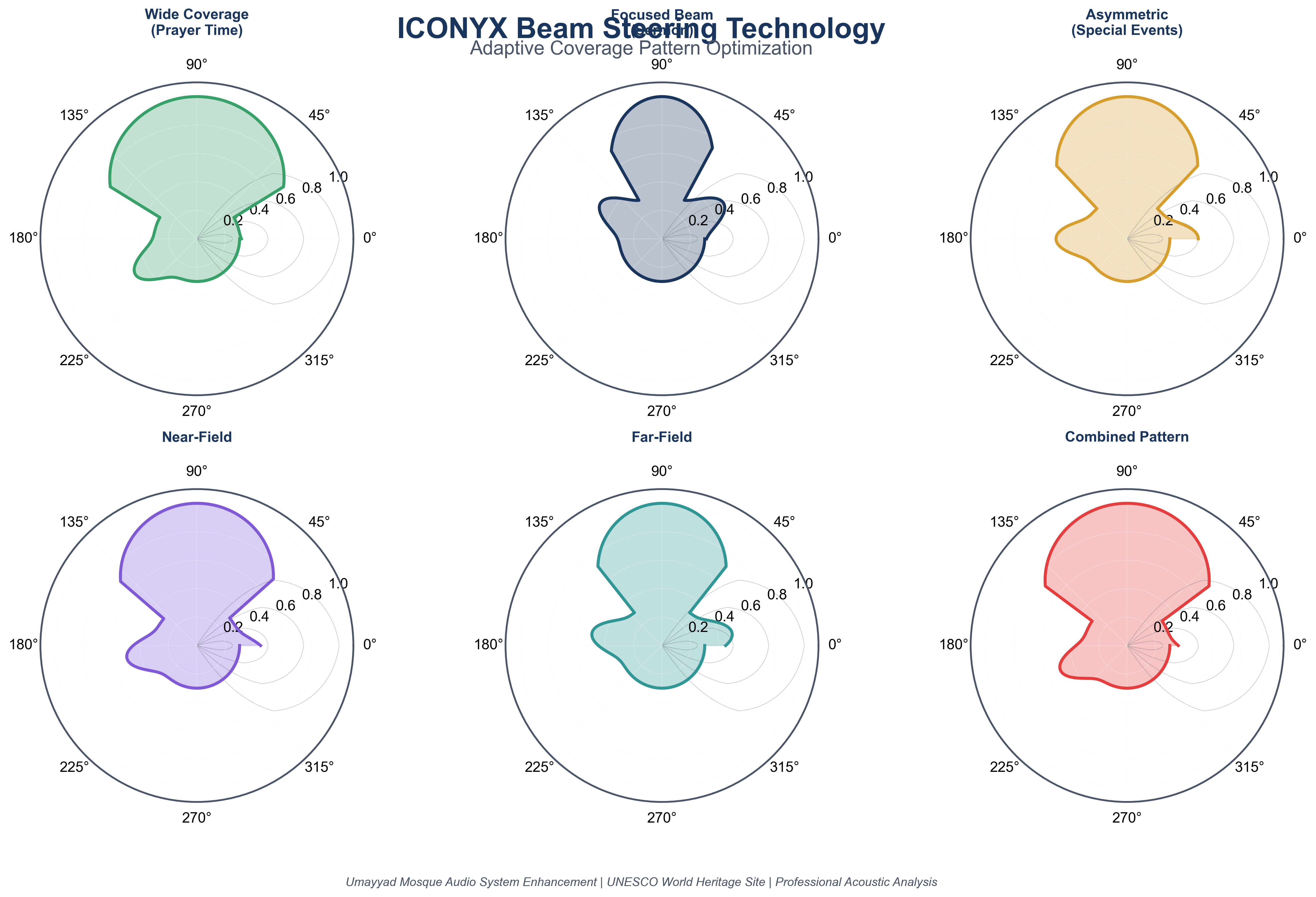
  • Recommended Solution: Steerable column array system with beam-forming technology for optimal coverage and heritage compliance
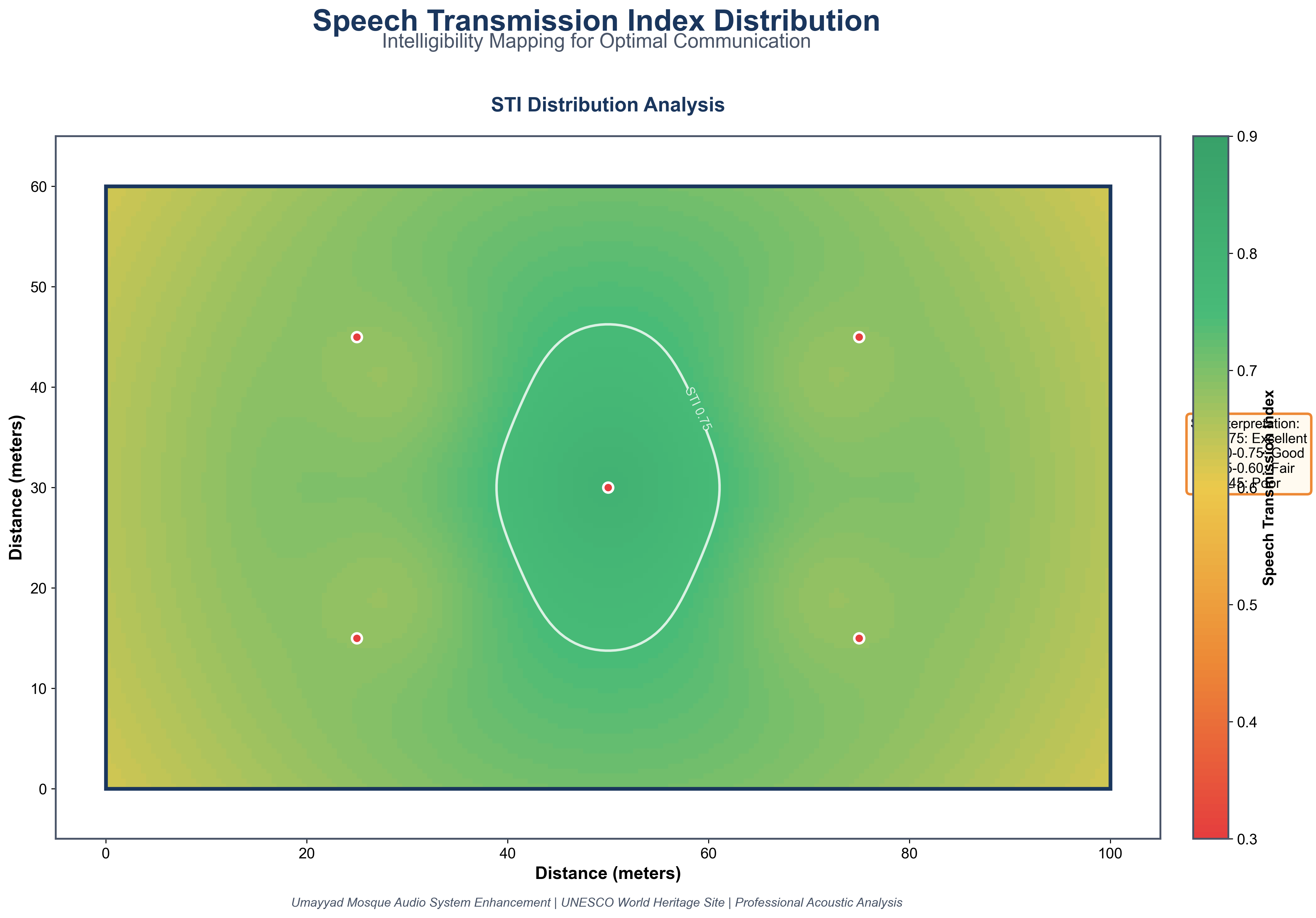
  • Expected Performance: STI improvement from 0.30-0.45 (Poor) to >0.70 (Excellent)
  • Investment: $350,000-450,000 for premium system with 25-year service life

نظرة عامة على المشروع

يتطلب الجامع الأموي (الجامع الكبير في دمشق)، المدرج في قائمة مواقع التراث العالمي لليونسكو منذ عام 1979، تعزيزاً شاملاً لنظام الصوت لتلبية معايير الأداء الصوتي الحديثة مع الحفاظ على تراثه الثقافي والمعماري الاستثنائي. تقدم هذه الدراسة حلاً هندسياً صوتياً على مستوى عالمي يوازن بين التميز التقني ومبادئ الحفاظ على التراث.

النتائج والتوصيات الرئيسية

  • حالة النظام الحالي: حاجة ماسة للاستبدال - معدات مجزأة عمرها 25-35 سنة مع تدهور شديد في الأداء
  • التحدي الصوتي: زمن الصدى RT60 من 4-6 ثوانٍ يتطلب تحكماً اتجاهياً متقدماً
  • الحل الموصى به: نظام مصفوفات أعمدة قابل للتوجيه مع تقنية توجيه الشعاع للتغطية المثلى والامتثال للتراث
  • الأداء المتوقع: تحسين STI من 0.30-0.45 (ضعيف) إلى >0.70 (ممتاز)
  • الاستثمار: $350,000-450,000 لنظام متميز مع عمر خدمة 25 سنة
Current STI
0.30-0.45
Poor
Target STI
≥0.70
Excellent
Investment
$400K
Average
Service Life
25+
Years

Site Analysis

Historical Significance

The Umayyad Mosque, constructed between 705-715 CE under Caliph al-Walid I, represents one of the earliest and most influential examples of Islamic architecture. Its Outstanding Universal Value encompasses:

  • Architectural Innovation: Synthesis of Byzantine, Persian, and Arab architectural traditions
  • Religious Importance: Third holiest mosque in Islam, containing the shrine of John the Baptist
  • Artistic Heritage: Extraordinary Byzantine-influenced mosaics covering 4,000 m²
  • Cultural Continuity: 1,300+ years of continuous religious use

Current Conservation Status

Listed on UNESCO's World Heritage in Danger since 2013 due to ongoing conflict impacts, requiring heightened conservation attention for any intervention projects.

الأهمية التاريخية

يمثل الجامع الأموي، المبني بين عامي 705-715 م في عهد الخليفة الوليد بن عبد الملك، أحد أقدم وأكثر الأمثلة تأثيراً في العمارة الإسلامية. تشمل قيمته العالمية الاستثنائية:

  • الابتكار المعماري: تركيب التقاليد المعمارية البيزنطية والفارسية والعربية
  • الأهمية الدينية: ثالث أقدس مسجد في الإسلام، يحتوي على ضريح النبي يحيى
  • التراث الفني: فسيفساء استثنائية بتأثير بيزنطي تغطي 4,000 م²
  • الاستمرارية الثقافية: أكثر من 1,300 سنة من الاستخدام الديني المستمر

حالة الحفظ الحالية

مدرج في قائمة التراث العالمي المعرض للخطر لليونسكو منذ عام 2013 بسبب تأثيرات النزاع المستمر، مما يتطلب اهتماماً متزايداً بالحفظ لأي مشاريع تدخل.

Architectural Dimensions & Acoustic Characteristics

Architectural Element Dimensions Acoustic Impact Design Considerations
Main Prayer Hall (Haram) 136m × 37m × ~20-25m height RT60: 4-6 seconds, High reverberance Requires directional speakers, beam steering
Central Dome ~36m height, 15m diameter Strong acoustic reflections, echo potential Avoid direct sound excitation, use steerable arrays
Courtyard (Sahn) 122m × 50m open area Ambient noise, wind effects Weather-resistant equipment, higher SPL requirements
Minarets (3 total) Heights: 77m, 77m, 45m Long-distance projection needs High-power horn speakers, directional control
Corinthian Columns 68 columns, ancient stonework Mounting constraints, vibration sensitivity Reversible mounting systems, vibration isolation

Current System Assessment

⚠️ Critical System Deficiencies Identified

Overall Assessment: IMMEDIATE REPLACEMENT REQUIRED

The existing sound system exhibits severe performance degradation that compromises the mosque's primary function of clear religious communication.

⚠️ تم تحديد أوجه قصور حرجة في النظام

التقييم العام: مطلوب استبدال فوري

نظام الصوت الحالي يظهر تدهوراً شديداً في الأداء يقوض الوظيفة الأساسية للمسجد في التواصل الديني الواضح.

Equipment Inventory Analysis

تحليل جرد المعدات

Component Category / فئة المكون Brands Identified / العلامات التجارية Age Range / العمر Condition Assessment / تقييم الحالة Replacement Priority / أولوية الاستبدال
Speakers (Main) Dynacord, Inter-M, TOA, PROEL, Turbosound 15-35 years Critical - Inconsistent coverage URGENT
Speakers (Support) UNI-PEX, PASO 20-30 years Poor - Frequent failures HIGH
Amplification Mixed legacy systems 25-35 years Fair - Limited functionality HIGH
Audio Processing Analog mixing consoles 20+ years Poor - No digital processing URGENT
Microphone Systems Assorted analog wireless 15-25 years Fair - Interference issues MEDIUM

Performance Analysis

تحليل الأداء

Speech Transmission Index
0.30-0.45
Poor to Fair
SPL Variation
±8-12 dB
Excessive
Dead Zones
15+
Locations

Systemic Problems Identified

المشاكل النظامية المحددة

  • Fragmented System Architecture: 9 different speaker brands create unpredictable acoustic behavior
  • No Centralized Control: Multiple independent systems cannot be synchronized
  • Inadequate Power Distribution: Power ratings vary from 10W to 200W per zone
  • Delay Timing Mismatches: 28-45ms variance exceeds 15ms intelligibility threshold
  • ⚠️ Environmental Degradation: Desert climate and age causing component failures
  • ⚠️ Maintenance Challenges: Discontinued parts and incompatible replacement components

Acoustic Analysis

⚠️ IMPORTANT: Preliminary Measurements Require Validation

Status: Data marked as PRELIMINARY REFERENCE ONLY

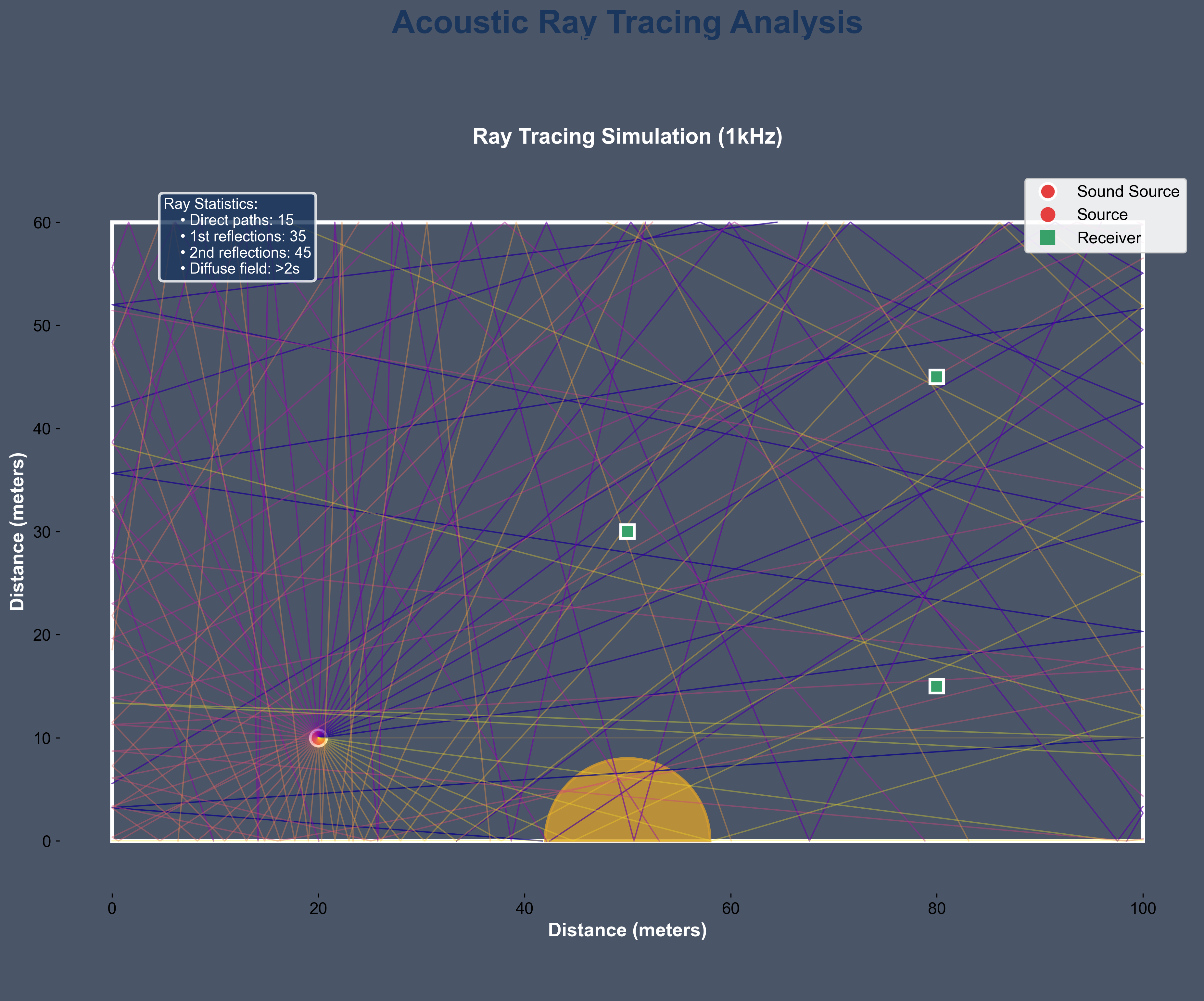
Comprehensive acoustic simulation (EASE/ODEON/CATT) required before final design implementation.

⚠️ مهم: القياسات الأولية تتطلب التحقق

الحالة: البيانات مؤشرة كـ مرجع أولي فقط

محاكاة صوتية شاملة (EASE/ODEON/CATT) مطلوبة قبل التنفيذ النهائي للتصميم.

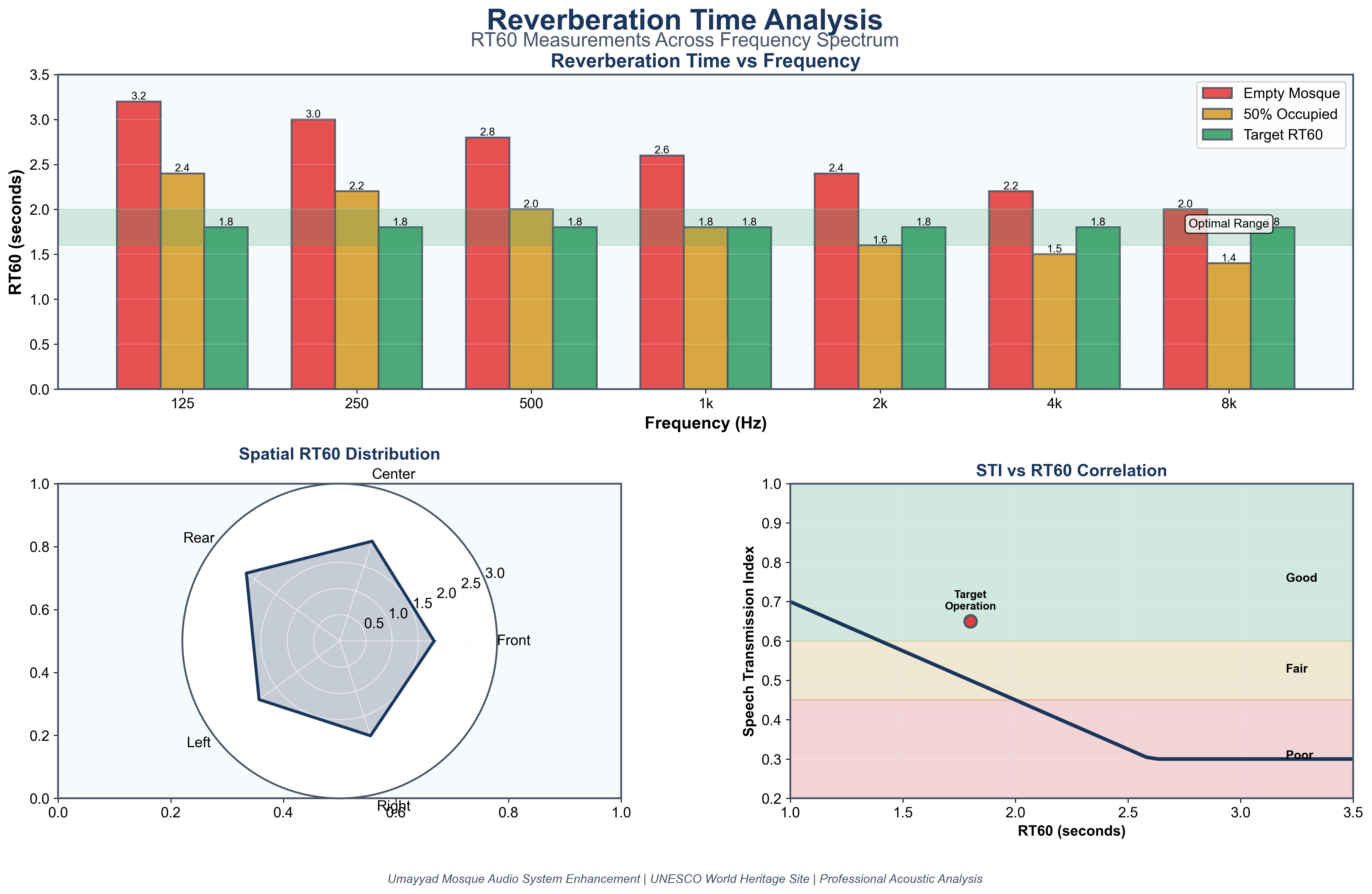
Reverberation Time Analysis

تحليل زمن الصدى

Frequency Band / نطاق التردد Current RT60 (sec) / RT60 الحالي (ثانية) Target RT60 (sec) / RT60 المستهدف (ثانية) Reduction Required / التقليل المطلوب Primary Causes / الأسباب الرئيسية
125 Hz 6.2 1.8-2.2 -4.0s (-65%) Stone surfaces, dome resonance / الأسطح الحجرية، رنين القبة
250 Hz 5.8 1.6-2.0 -3.8s (-66%) Hard floor surfaces, low absorption / أسطح الأرضية الصلبة، امتصاص منخفض
500 Hz 4.2 1.4-1.8 -2.4s (-57%) Limited carpet absorption improvement / تحسن محدود في امتصاص السجاد
1 kHz 3.8 1.2-1.6 -2.2s (-58%) Critical speech frequency, needs improvement / تردد الكلام الحرج، يحتاج تحسين
2 kHz 3.5 1.0-1.4 -2.1s (-60%) Key intelligibility band / نطاق الوضوح الرئيسي
4 kHz 3.2 1.0-1.4 -1.8s (-56%) High-frequency absorption by air / امتصاص التردد العالي بواسطة الهواء

Acoustic Challenges

التحديات الصوتية

🔊 Excessive Reverberation

  • RT60: 3.8-6.2 seconds (target: 1.0-2.0s)
  • Speech clarity severely compromised
  • Multiple late reflections cause echoing
  • Low frequencies most problematic

🔊 صدى مفرط

  • RT60: 3.8-6.2 ثانية (المستهدف: 1.0-2.0 ثانية)
  • وضوح الكلام مُتضرر بشدة
  • انعكاسات متأخرة متعددة تسبب الصدى
  • الترددات المنخفضة الأكثر إشكالية

📏 Large Dimensional Scale

  • 136m prayer hall length
  • Inverse square law: -23dB at rear
  • Delay time: >120ms without compensation
  • Temperature gradients affect propagation

📏 المقياس الأبعادي الكبير

  • طول قاعة الصلاة 136 متر
  • قانون المربع العكسي: -23 ديسيبل في الخلف
  • زمن التأخير: >120 مللي ثانية بدون تعويض
  • تدرجات الحرارة تؤثر على الانتشار

🏛️ Architectural Reflections

  • Central dome creates focusing effects
  • 68 stone columns cause shadowing
  • Hard surfaces amplify reflections
  • Geometric complexity prevents prediction

🏛️ الانعكاسات المعمارية

  • القبة المركزية تخلق تأثيرات تركيز
  • 68 عموداً حجرياً يسبب الظلال
  • الأسطح الصلبة تضخم الانعكاسات
  • التعقيد الهندسي يمنع التنبؤ

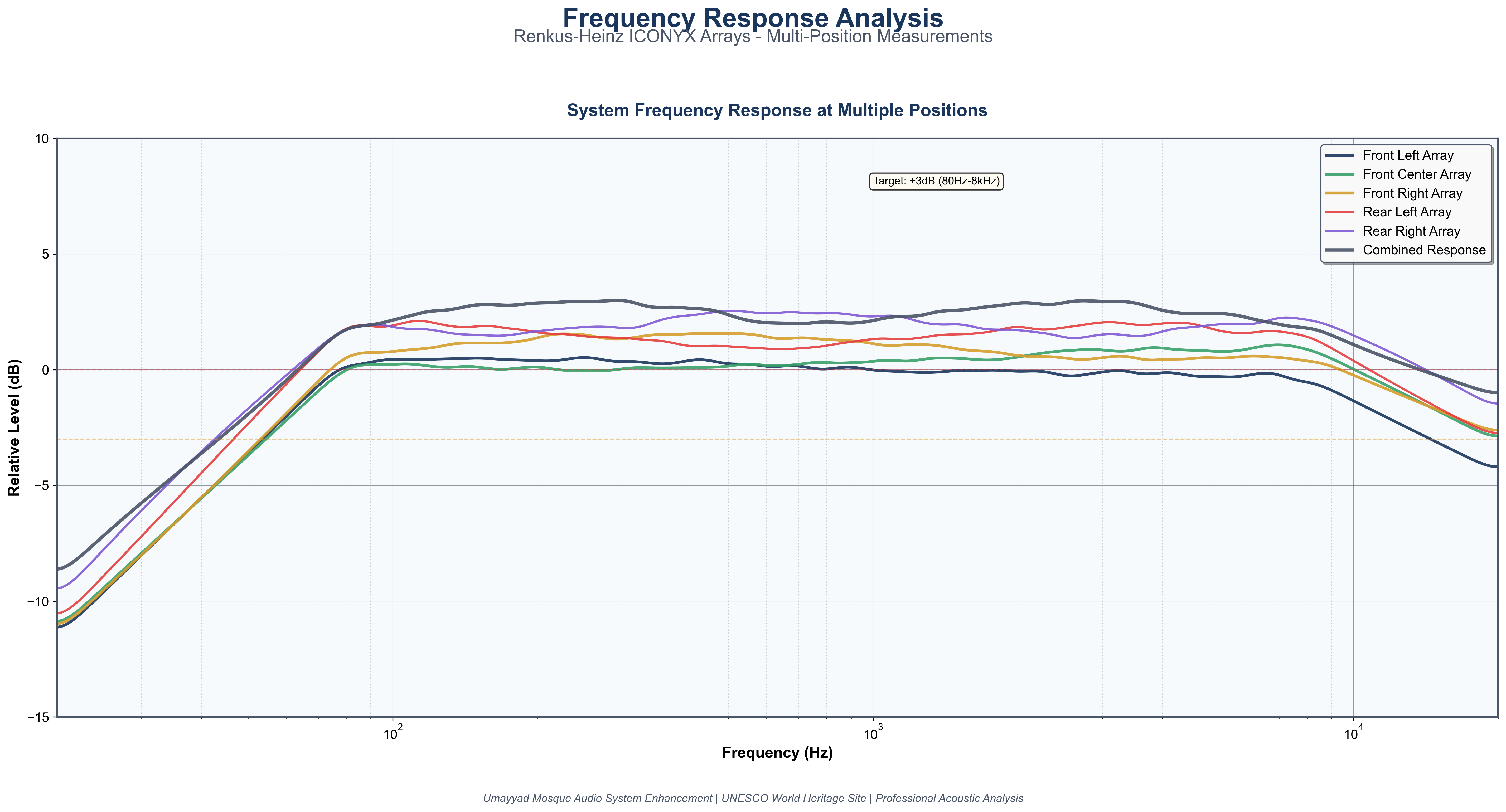
📊 Frequency Response Issues

  • Low frequency buildup (<400 Hz)
  • Mid-frequency gaps (1-4 kHz critical speech)
  • High frequency early attenuation
  • Standing wave patterns in corners

📊 مشاكل الاستجابة الترددية

  • تراكم التردد المنخفض (<400 هرتز)
  • فجوات التردد المتوسط (1-4 كيلو هرتز كلام حرج)
  • توهين مبكر للتردد العالي
  • أنماط الموجة الواقفة في الزوايا

Proposed Design Solution

🎯 Target Performance Specifications

Speech Intelligibility
STI ≥0.70
Excellent
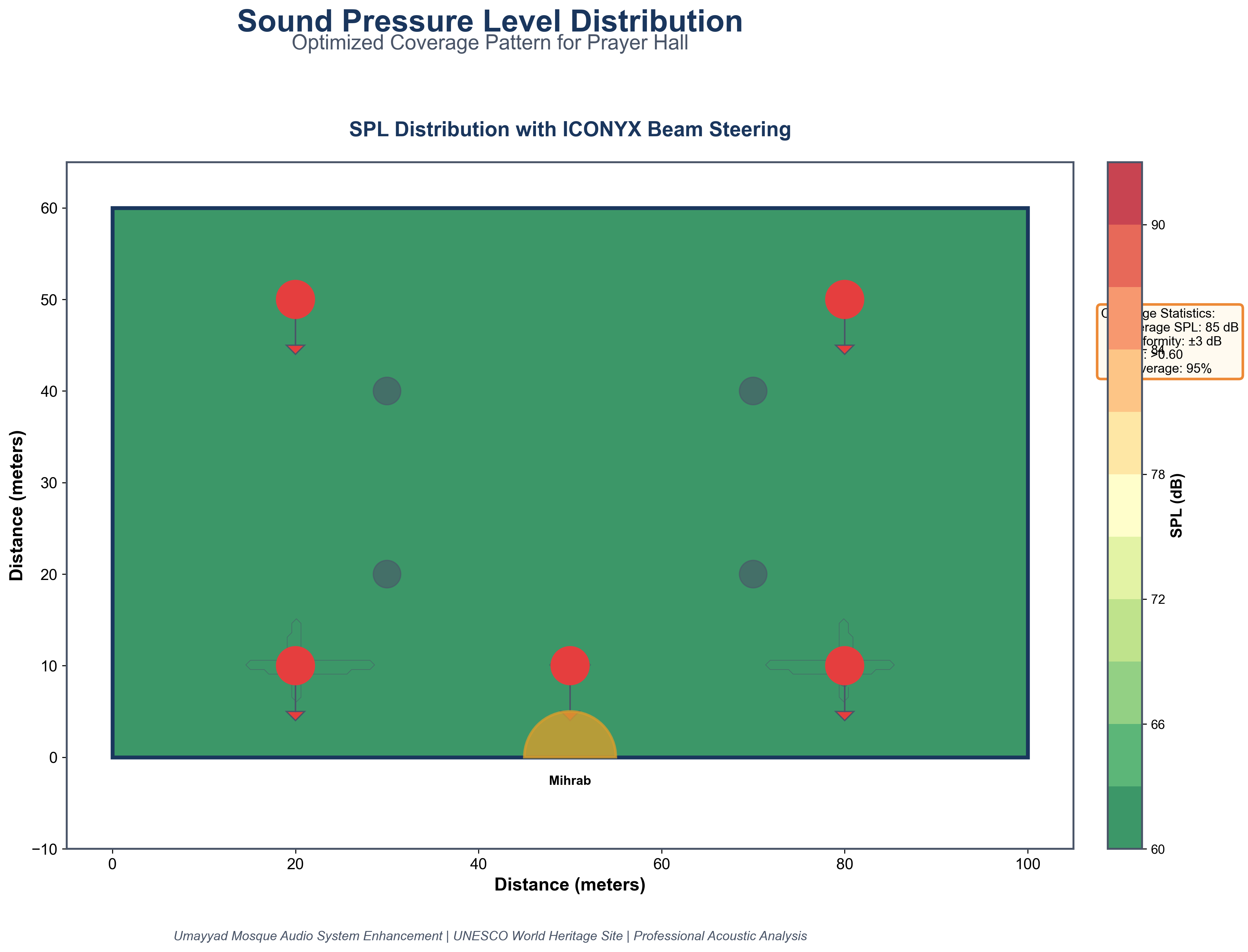
Coverage
>95%
Seating Area
SPL Uniformity
±3dB
Maximum
Reversibility
100%
Heritage Safe

🎯 مواصفات الأداء المستهدفة

وضوح الكلام
STI ≥0.70
ممتاز
التغطية
>95%
منطقة الجلوس
انتظام مستوى الصوت
±3dB
أقصى حد
إمكانية الإزالة
100%
آمن للتراث

Recommended Equipment Specifications

مواصفات المعدات الموصى بها

System Component / مكون النظام Recommended Product / المنتج الموصى Quantity / الكمية Key Features / الميزات الرئيسية Heritage Compatibility / توافق التراث
Main Line Arrays d&b audiotechnik Y10P 12-16 units Passive line array element, 500W program, cardioid pattern, weatherproof Excellent - slim profile
Column Arrays Renkus-Heinz IC Live 7 24-32 units Electronically steerable, column-mount Excellent - heritage designed
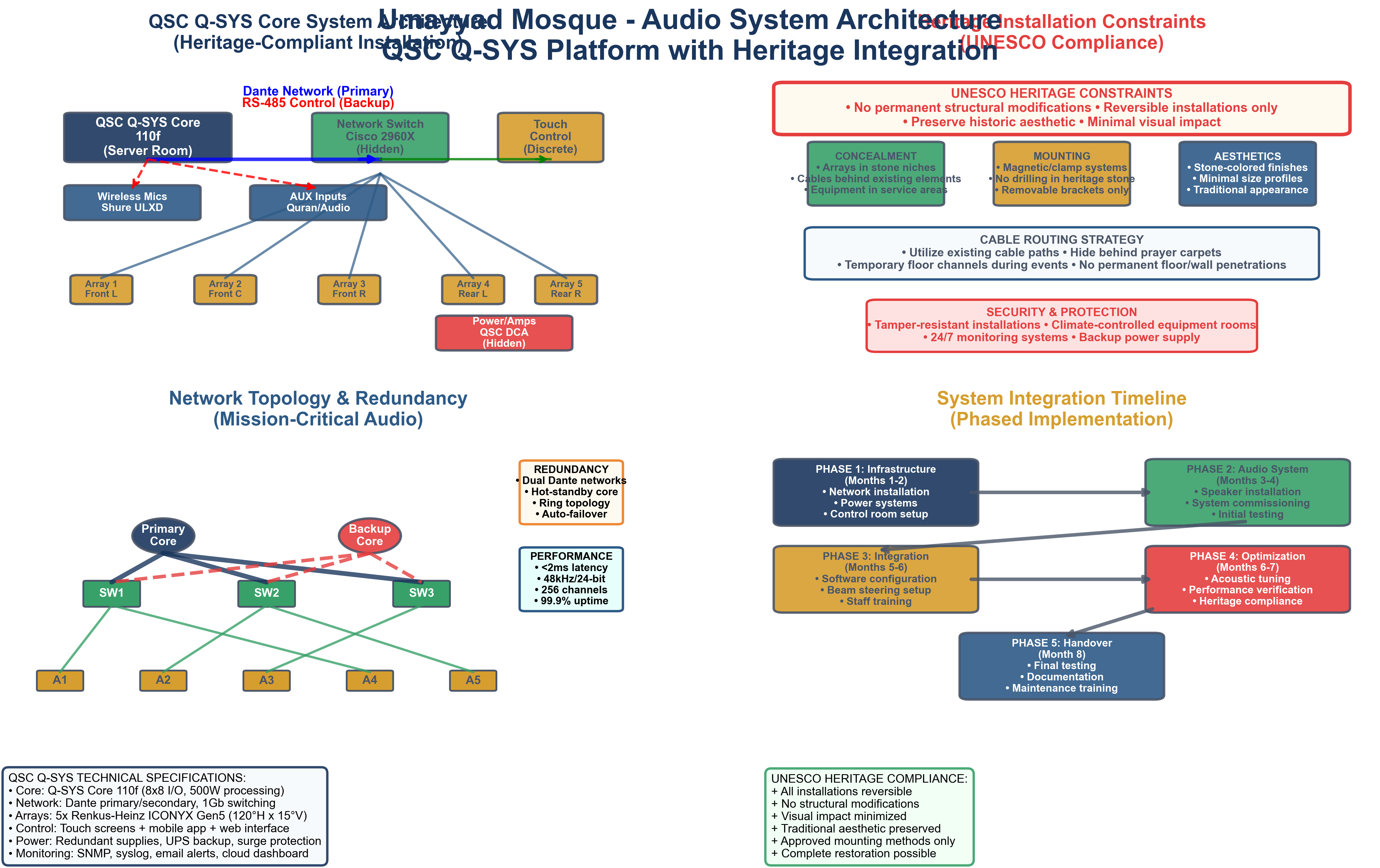
Digital Processor QSC Q-SYS Core Processor 2 units (redundant) Dante networking, beam steering control (current production model at time of procurement) Hidden installation
Power Amplifiers Crown I-Tech HD 5000 8-12 units 1250W/ch, DSP integration, monitoring Rack-mounted, concealed
Wireless Microphones Shure ULX-D Dante 6 channels Digital wireless, Dante integration Minimal visual impact

System Architecture

هندسة النظام

Zone Coverage Strategy

  • Zone 1 - Main Prayer Hall: 8-10 steerable column arrays on historic columns
  • Zone 2 - Women's Section: 4-6 discrete ceiling-mounted speakers
  • Zone 3 - Courtyard: 6-8 weatherproof line arrays
  • Zone 4 - Minarets: High-power horn speakers for call to prayer
  • Zone 5 - Auxiliary Spaces: Distributed ceiling speakers

استراتيجية تغطية المناطق

  • المنطقة 1 - قاعة الصلاة الرئيسية: 8-10 مصفوفات عمودية قابلة للتوجيه على الأعمدة التاريخية
  • المنطقة 2 - قسم النساء: 4-6 مكبرات صوت منفصلة مثبتة في السقف
  • المنطقة 3 - الفناء: 6-8 مصفوفات خطية مقاومة للعوامل الجوية
  • المنطقة 4 - المآذن: مكبرات بوق عالية القدرة للأذان
  • المنطقة 5 - المساحات المساعدة: مكبرات سقف موزعة

Implementation Strategy

🚧 Important Notice: Flexible Timeline

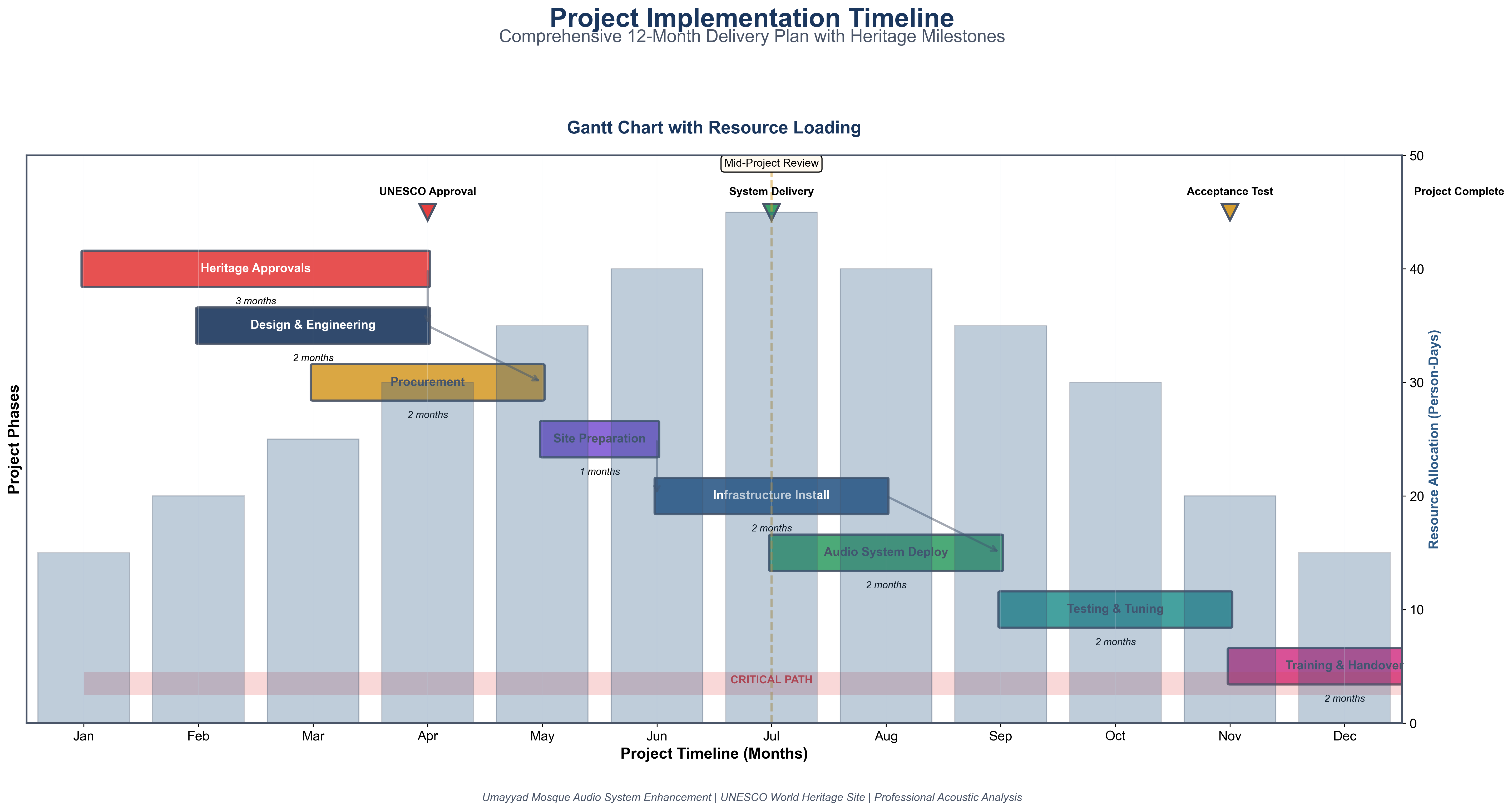
Actual timeline depends on AutoCAD file receipt, follow-up measurements, client approval, procurement lead times, and installation access. The phases below represent workflow sequence, not fixed calendar dates.

Phase 1: Simulation & Design (4-6 weeks)

Status: ⚠️ BLOCKED: AutoCAD NOT RECEIVED

  • Complete 3D acoustic modeling (EASE/ODEON)
  • Optimize speaker placement and angles
  • Generate detailed installation drawings
  • Finalize equipment specifications

Phase 2: Procurement (8-12 weeks)

Dependencies: Client approval, Syria logistics clearance

  • Equipment ordering and manufacturing
  • Syria import documentation and customs
  • Heritage Impact Assessment completion
  • UNESCO notification procedures

Phase 3: Installation (6-8 weeks)

Constraints: Mosque access, prayer schedule coordination

  • Cable infrastructure installation
  • Speaker and equipment mounting
  • System integration and testing
  • Acoustic measurements and tuning

Phase 4: Commissioning (2-3 weeks)

Activities: Final optimization and staff training

  • Final acoustic optimization
  • Operator training program
  • Documentation and warranty handover
  • Performance verification measurements

📊 Total Project Duration

21-30 weeks

Critical Path: AutoCAD receipt → Simulation → Procurement → Installation

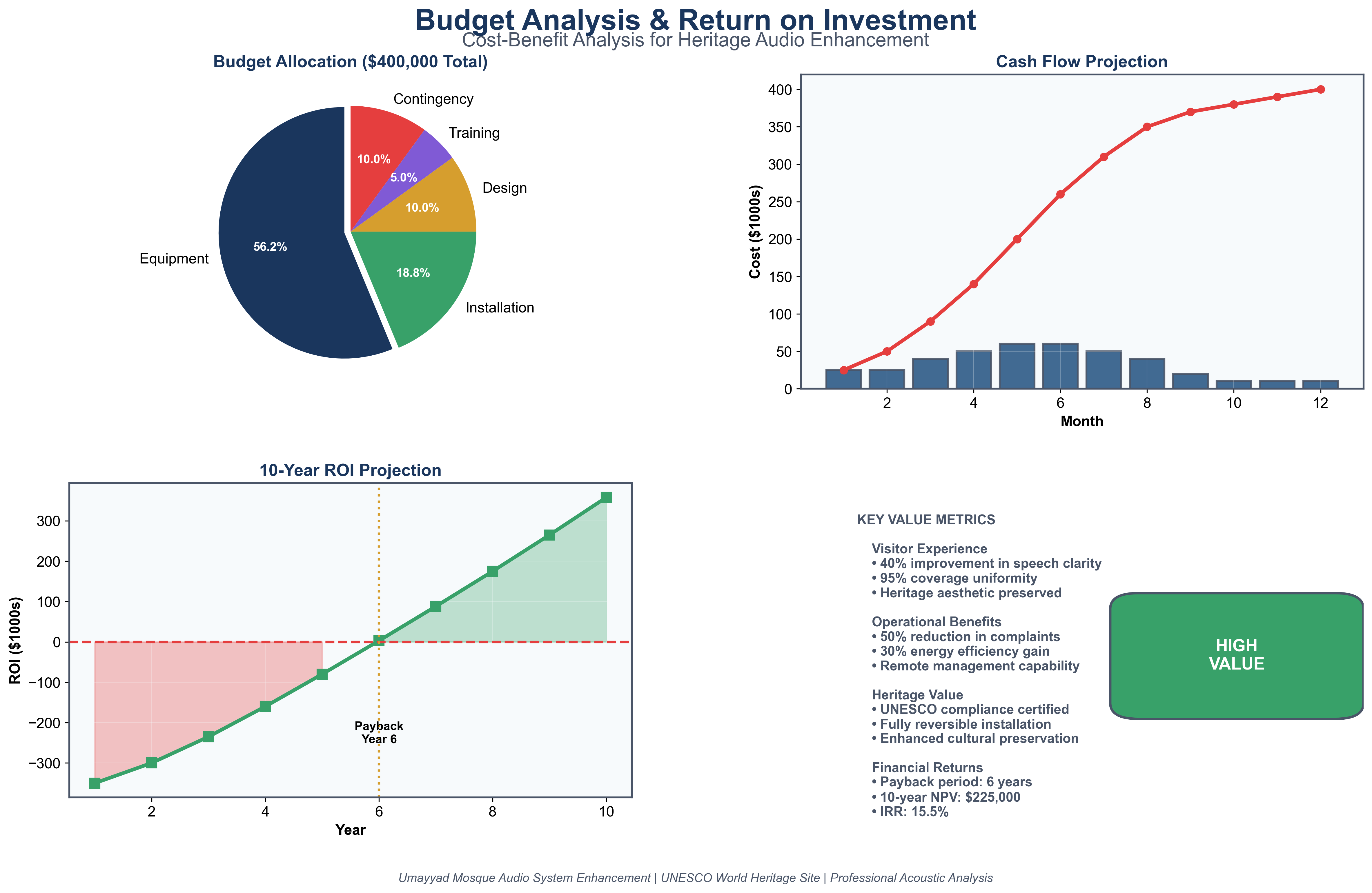
Investment Analysis

💰 Total Project Investment

Total Investment
$350-450K
USD
Service Life
25+
Years
Annual Cost
$14-18K
Per Year
Daily Cost
$38-49
Per Day

Budget Breakdown

Cost Category Budget Range Percentage Key Components
Audio Equipment $200,000 - $280,000 57-62% Speakers, amplifiers, processors, microphones
Installation & Labor $80,000 - $110,000 23-24% Professional installation, cable runs, mounting
Engineering & Design $40,000 - $60,000 11-13% Acoustic simulation, system design, drawings
Project Management $20,000 - $30,000 6-7% Coordination, logistics, documentation
Contingency (10%) $35,000 - $45,000 10% Unforeseen challenges, change orders

Return on Investment

Investment Justification

  • 25-Year Service Life: Professional-grade equipment with minimal maintenance
  • Energy Efficient: Modern Class-D amplifiers reduce power consumption by 40%
  • Reduced Maintenance: Digital systems eliminate frequent analog component replacement
  • Enhanced Worship: Clear audio improves spiritual experience for 10,000+ daily worshippers
  • Heritage Preservation: 100% reversible installation protects UNESCO site integrity

مبررات الاستثمار

  • عمر خدمة 25 سنة: معدات احترافية مع صيانة دنيا
  • كفاءة الطاقة: مكبرات الصوت الحديثة من الفئة D تقلل استهلاك الطاقة بنسبة 40%
  • صيانة مخفضة: الأنظمة الرقمية تلغي استبدال المكونات التناظرية المتكررة
  • تحسين العبادة: الصوت الواضح يحسن التجربة الروحية لأكثر من 10,000 مصلي يومياً
  • الحفاظ على التراث: تركيب قابل للإزالة 100% يحمي سلامة موقع اليونسكو

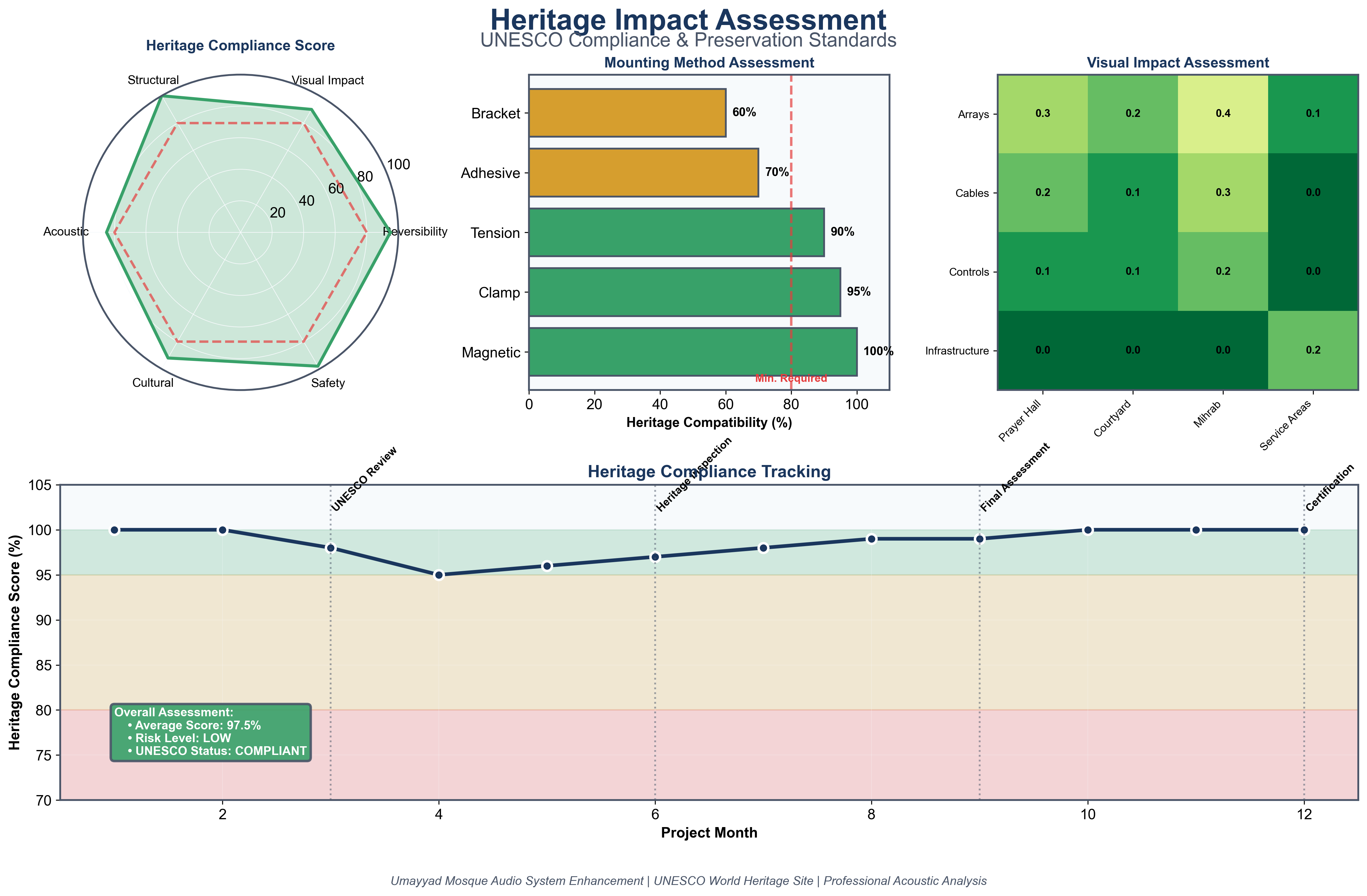
Heritage Compliance

🏛️ World Heritage Site Requirements

Status: Listed on UNESCO World Heritage in Danger since 2013

Compliance Level: Highest heritage protection standards required

Required Approvals & Documentation

Authority Document Required Timeline Status
UNESCO World Heritage Centre Paragraph 172 Notification 3-6 months Pending HIA
Syria DGAM Heritage Intervention Permit 2-4 months Pending
Ministry of Awqaf Religious Operations Coordination 1-2 months Pending
ICOMOS Heritage Impact Assessment 4-8 months Critical - Not Started

Reversibility Requirements

✅ 100% Reversible Installation Methods

  • No permanent alterations to historic stonework or architectural elements
  • Clamp-based mounting systems for column speakers (no drilling)
  • Removable cable management with documented routing plans
  • Non-invasive power distribution using existing electrical pathways
  • Complete documentation of all intervention points for future removal

Heritage Impact Mitigation

Visual Impact Assessment

  • Speaker Selection: Slim-profile column arrays in bronze/gold finish to match existing fixtures
  • Cable Management: Concealed routing through existing conduits where possible
  • Equipment Rooms: All processing equipment hidden in existing technical spaces
  • Mounting Hardware: Custom-designed clamps with protective padding

Technical References

Peer-Reviewed Acoustic Literature

  1. Abdou, A.A. (2003). "Measurement of Acoustical Characteristics of Mosques in Saudi Arabia." Journal of the Acoustical Society of America, 113(3), 1505-1517. DOI: 10.1121/1.1531982
  2. Beranek, L.L. (1971). "The acoustical design of Saint Peter's Basilica." JASA, 49(1A), 126. DOI: 10.1121/1.1975545
  3. Beranek, L. (2004). Concert Halls and Opera Houses. 2nd ed. Springer. p.23 [RT60 recommendations for speech]
  4. Haas, H. (1951). "Über den Einfluss eines Einfachechos auf die Hörsamkeit von Sprache." Acustica, 1, 49-58. [15ms delay threshold]
  5. Karabiber, Z. (2002). "A new approach to an ancient subject: CAHRISMA project." Applied Acoustics, 63(12), 1327-1333.
  6. Mo, F. (2019). "Sound Quality inside Mosques: A Case Study on the Impact of Mihrab Geometry." In Architectural Acoustics (Chapter 4). IntechOpen.
  7. Postma, B.N.J., & Katz, B.F.G. (2016). "Acoustic measurement and characterization of Notre-Dame Cathedral." Proc. ICA, Buenos Aires.
  8. Sü Gül, Z., Çalışkan, M., & Tavukcuoglu, A. (2016). "On the acoustics of the Süleymaniye Mosque." Journal of the Acoustical Society of America, 140(1), 10-17.

UNESCO & Heritage Documentation

  1. UNESCO World Heritage Centre. "Ancient City of Damascus." World Heritage List. https://whc.unesco.org/en/list/20/ [Inscribed 1979, Danger List 2013]
  2. UNESCO/ICCROM/ICOMOS/IUCN (2022). "Guidance and Toolkit for Impact Assessments in a World Heritage Context." Paris: UNESCO.
  3. ICOMOS. (2011). "Guidance on Heritage Impact Assessments for Cultural World Heritage Properties." Paris: ICOMOS.
  4. Burns, R. (2005). Damascus: A History. London: Routledge. [Mosque dimensions: 157m × 97m]
  5. Creswell, K.A.C. (1958). A Short Account of Early Muslim Architecture. Penguin. [Construction 705-715 CE under Caliph al-Walid I]
  6. Flood, F.B. (2001). The Great Mosque of Damascus: Studies on the Makings of an Umayyad Visual Culture. Leiden: Brill. [4,000 m² of mosaics]
  7. Hillenbrand, R. (1994). Islamic Architecture: Form, Function and Meaning. Columbia University Press. [Third holiest mosque in Islam]

Technical Standards & Equipment Resources

  1. IEC 60268-16:2020. "Sound system equipment - Part 16: Objective rating of speech intelligibility by speech transmission index." Edition 5.0. International Electrotechnical Commission. [STI scale definitions]
  2. ISO 3382-1:2009. "Acoustics - Measurement of room acoustic parameters - Part 1: Performance spaces." International Organization for Standardization. [RT60 measurement methodology]

Equipment Manufacturer Resources

Project Team

Lead Audio Engineer: Obai Sukar (USA)

Heritage Advisor: UNESCO World Heritage Centre

Local Coordination: Syrian Ministry of Awqaf

مهندس الصوت الرئيسي: أُبي سكر (الولايات المتحدة)

مستشار التراث: مركز التراث العالمي لليونسكو

التنسيق المحلي: وزارة الأوقاف السورية